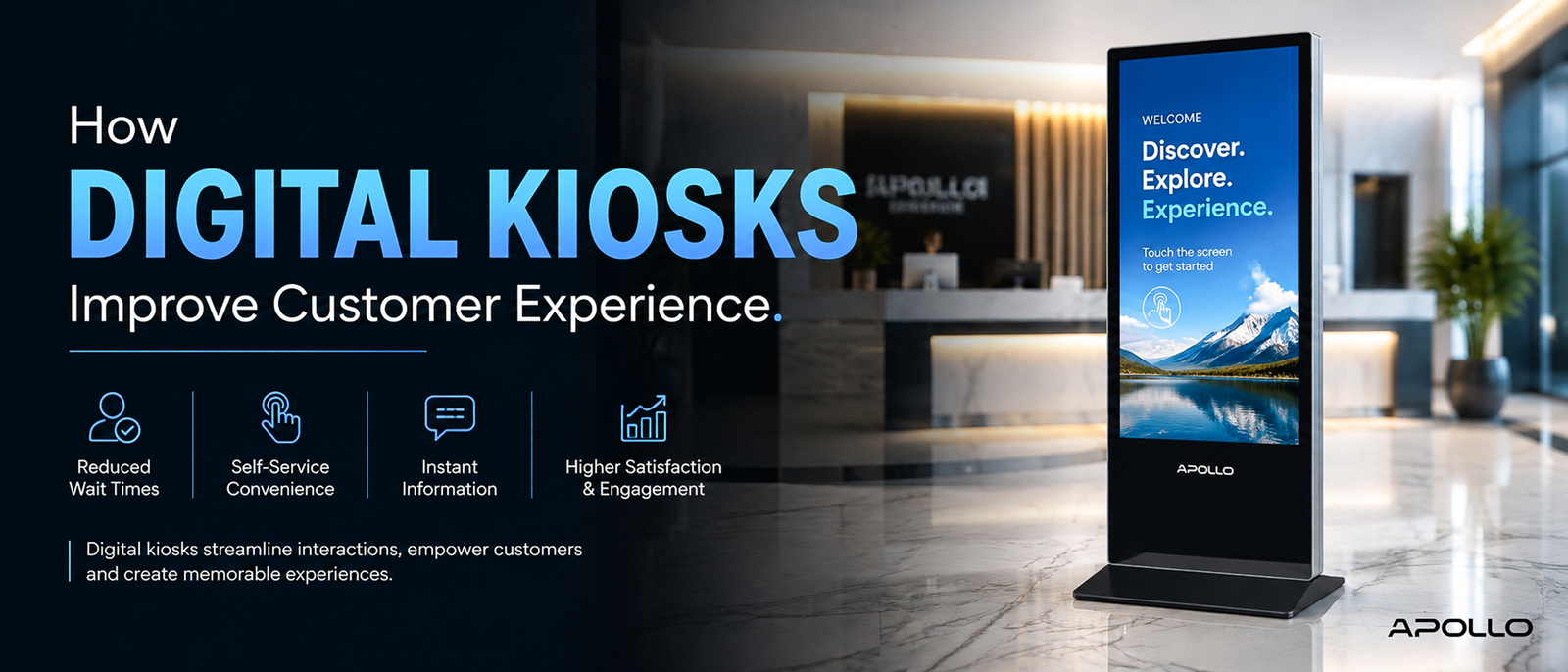

This guide breaks down the top benefits of digital signage for corporate environments — from cost savings and customer engagement to operational efficiency — so you can evaluate whether it's genuinely worth the investment for your organization.
Here's something most business owners don't realize until it's too late: every day a printed sign hangs on your wall is a day it's quietly losing relevance, accuracy, or impact. Prices change, promotions expire, and information goes stale — while the sign just sits there, unaware. Digital signage fixes that problem entirely, and the benefits go far beyond simply "looking more modern."
Why Digital Signage Has Become a Business Standard
Across retail, hospitality, healthcare, and corporate offices, digital signage has shifted from a "nice to have" to a practical operational tool. The reasons aren't cosmetic — they're measurable, ranging from reduced printing costs to faster communication across multiple locations.
1. Instant Content Updates Without Reprinting Costs
Perhaps the most immediate benefit: content can be changed in seconds rather than days. No design-to-print turnaround, no physical replacement, no wasted materials when a promotion ends early or pricing changes unexpectedly.
- Update pricing, menus, or promotions remotely and instantly
- Eliminate recurring printing costs for posters, banners, and menu boards
- Reduce waste from outdated or discarded printed materials
2. Centralized Management Across Multiple Locations
For businesses with more than one location, digital signage solves a coordination problem that printed signage simply can't. A single content management system (CMS) can push updates to dozens or hundreds of screens simultaneously.
- Roll out consistent branding and messaging across every location at once
- Schedule region-specific or store-specific content without manual intervention
- Reduce the administrative burden of coordinating printed material distribution
3. Higher Customer Engagement Through Motion and Visual Impact
Static signs blend into the background over time — a phenomenon researchers call "banner blindness." Digital signage, with subtle motion, video, and dynamic content, tends to capture attention more effectively than a printed equivalent in the same location.
- Motion naturally draws the eye more than static images
- Video content can communicate more information in less time than text-heavy posters
- Rotating content keeps repeat visitors engaged rather than tuning out familiar signage
4. Improved Operational Efficiency
Beyond marketing, digital signage supports day-to-day operations in ways printed signs can't:
- Dayparting — Automatically switch menus, promotions, or messaging by time of day
- Real-time data integration — Display live inventory levels, queue times, or weather updates
- Emergency communication — Instantly broadcast urgent updates across all connected screens if needed
5. Stronger Brand Consistency
Digital signage makes it far easier to maintain consistent branding — colors, fonts, tone, and messaging — across every customer touchpoint, since updates are centrally controlled rather than dependent on local printing quality or availability.
- Ensure every location displays approved, on-brand messaging
- Avoid inconsistent or outdated printed materials lingering at individual sites
- Maintain visual consistency between in-store signage and digital marketing channels
6. Better Customer Experience and Wayfinding
In larger facilities — hospitals, corporate campuses, shopping centers — digital signage significantly improves navigation and reduces visitor frustration.
- Interactive or static wayfinding displays help visitors find departments, stores, or meeting rooms faster
- Real-time updates (delays, closures, schedule changes) reduce confusion compared to static maps
- Reduces staff time spent giving directions or repeating basic information
7. Long-Term Cost Savings
While the upfront investment in digital signage hardware is higher than printing a poster, the long-term economics often favor digital, especially for businesses that update content frequently.
| Factor | Printed Signage | Digital Signage |
|---|---|---|
| Update cost | Recurring printing costs | Effectively free after setup |
| Update speed | Days (design, print, install) | Instant |
| Multi-location consistency | Difficult to maintain | Centrally controlled |
| Long-term cost (frequent updates) | Higher over time | Lower over time |
Businesses that change pricing, promotions, or messaging often typically recover the initial signage investment faster than those with rarely-changing content.
8. Data-Driven Content Optimization
Modern digital signage platforms often allow businesses to test which content performs best — similar to A/B testing in digital marketing — something entirely impossible with static printed signage.
- Rotate different promotional layouts and compare results
- Adjust content based on time-of-day performance data
- Refine messaging based on what actually influences customer behavior, rather than guesswork
Which Businesses Benefit Most From Digital Signage?
While nearly any business can benefit, the advantages are most pronounced for organizations that:
- Operate multiple locations needing consistent, centrally managed messaging
- Update pricing, menus, or promotions frequently
- Serve high foot-traffic environments where engagement and wayfinding matter
- Need to communicate time-sensitive or real-time information
Common Misconceptions About Digital Signage
- "It's too expensive for smaller businesses" — Entry-level signage solutions have become significantly more affordable and scalable
- "It requires a dedicated IT team to manage" — Most modern content management platforms are designed for non-technical staff
- "It's just for advertising" — Digital signage also supports wayfinding, operational data display, and internal communications
- "Content needs to be updated constantly to be worth it" — Even infrequent but timely updates outperform static printed signage in most measurable ways
FAQ: Top Benefits of Digital Signage
1. What is the biggest advantage of digital signage over printed signs? The ability to update content instantly and remotely, eliminating recurring printing costs and delays, is generally considered the most significant advantage.
2. Does digital signage actually increase customer engagement? Yes — motion and dynamic content typically capture more attention than static displays, helping reduce the "banner blindness" effect common with printed signage.
3. Is digital signage worth it for a single-location business? It can be, particularly if pricing, promotions, or menus change frequently, since the cost savings from eliminating reprints often offset the initial investment over time.
4. Can digital signage help with internal business communication, not just customer-facing marketing? Yes — many organizations use digital signage for internal updates, wayfinding, meeting room schedules, and real-time operational data alongside customer-facing content.
5. How difficult is it to manage digital signage content on a daily basis? Most modern platforms are built for non-technical users, allowing content updates, scheduling, and multi-location management without specialized IT support.
The top benefits of digital signage go well beyond visual appeal — instant content updates, centralized multi-location management, improved engagement, and measurable long-term cost savings make it a genuinely practical investment for modern businesses. Organizations that update content regularly or operate across multiple locations tend to see the clearest return on that investment.
Ready to explore digital signage solutions for your business? Reach out to Apollo Vision Tech to find display hardware and content management options built for how your organization actually communicates.